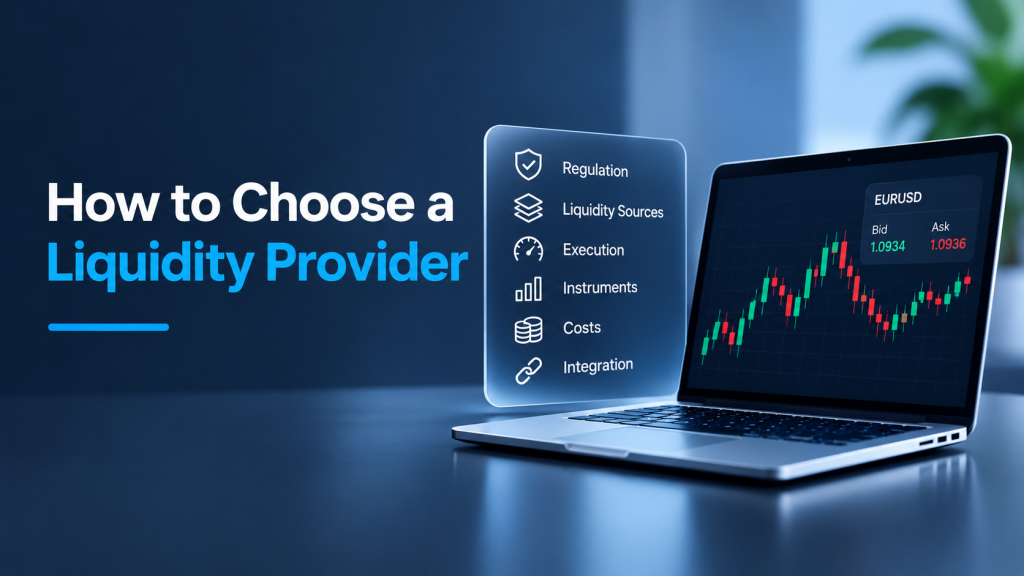
A liquidity provider can offer your brokerage competitive spreads on paper but still deliver poor execution when trading volumes rise or markets become volatile. That difference matters because the price your clients see is not always the price at which their orders can be filled. Knowing how to choose a liquidity provider means looking beyond advertised spreads. You need to establish who supplies the prices, whether sufficient liquidity is available, how orders are executed, and what your brokerage will pay.
This guide covers the questions to ask before signing, when to use a Prime of Prime provider instead of approaching banks directly, and how to calculate liquidity costs.
How to Choose a Liquidity Provider
A forex liquidity provider supplies bid and ask prices and, depending on the arrangement, executes trades or provides the liquidity your brokerage needs to hedge its exposure.
Banks, non-bank market makers, and Prime of Prime firms can all provide access to liquidity, but they operate under different commercial and technical arrangements.
The right provider depends on your brokerage’s trading volumes, instruments, execution model, and available capital.
Before comparing quotations, establish which trades you intend to pass to external counterparties, the order sizes you expect, and the platforms your business uses.
Then work through the following questions.
9 Questions to Ask Before Choosing a Liquidity Provider
1. Is the Liquidity Provider Regulated?
Start by identifying the legal entity that will sign your agreement.
A provider may operate under a well-known group name, but the company handling your account could be registered in a different jurisdiction.
Ask for its legal name, regulatory licence number, and the authority supervising its activities.
Check the details against the regulator’s official register, including whether the permissions cover the services being offered.
Also establish where your brokerage’s margin or collateral will be held and what happens to those funds if the provider becomes insolvent.
A company’s regulatory status should never be assumed from its marketing materials or the reputation of another company within its group.
2. Which Banks and Non-Bank Institutions Supply the Liquidity?
Not every provider quoting institutional liquidity has a direct relationship with a major bank.
Some receive prices from banks, while others use non-bank market makers, electronic trading venues, or other intermediaries.
Ask which institutions contribute to the pricing your brokerage receives and whether the provider aggregates several sources.
Where the provider cannot disclose individual counterparties, request an explanation of the types of institutions involved and how its liquidity arrangements work.
You should also establish whether those sources are independent.
For example, several price feeds may still depend on one upstream credit relationship. If that relationship becomes unavailable, the number of displayed feeds may offer little protection.
3. How Competitive Are the Spreads and Available Liquidity?
A tight spread is useful only when your brokerage can execute the required order size at or near the quoted price.
Ask the provider to demonstrate its pricing across the instruments you intend to offer.
Compare spreads during the London and New York trading sessions, quieter periods, and major economic announcements.
You should also examine market depth, which shows the amount available at different price levels.
For example, a provider may quote EUR/USD with a spread of 0.1 pip but offer limited volume at the best price. A larger order may therefore execute across several price levels, increasing its effective cost.
Ask for pricing and depth data that reflect the order sizes your clients typically trade.
4. How Are Orders Executed?
Execution quality matters as much as the quoted spread.
Ask whether the provider uses immediate execution, request-for-quote arrangements, or other execution methods.
Find out whether it applies last look, where a liquidity provider has a short opportunity to accept or reject a trade request after receiving it.
Request historical execution statistics covering:
- Average execution time
- Order rejection rates
- Positive and negative slippage
- Partial fills
- Execution performance during volatile markets
Slippage occurs when an order executes at a different price from the one requested.
For example, a client submits a buy order at 1.10000, but the order executes at 1.10008. The difference is 0.8 pip of negative slippage.
A provider should be able to explain how orders are handled and what happens when the requested price or volume is unavailable.
5. Which Instruments Does the Provider Cover?
Your liquidity provider must support the products your brokerage intends to offer.
These may include major and minor forex pairs, precious metals, indices, commodities, and CFDs on other underlying assets.
However, instrument availability alone is not enough.
Ask whether pricing, trading hours, margin requirements, and execution conditions differ between instruments.
For example, a provider offering competitive EUR/USD pricing may have wider spreads or less depth in exotic currency pairs.
Request the full instrument specification and compare it against your planned product offering.
6. How Does the Provider Connect to Your Trading Platform?
Your trading platform needs a reliable connection to the liquidity provider.
A liquidity bridge transfers pricing and order information between the platform and the execution infrastructure.
Depending on the setup, the provider may support FIX API connections, dedicated gateways, or bridges compatible with platforms such as MT4 and MT5.
Ask whether your existing bridge is supported or whether you need another integration.
Check who handles the installation, symbol mapping, testing, maintenance, and technical support.
Also establish whether the connection supports your brokerage’s risk management and order-routing requirements.
7. What Are the Margin and Credit Terms?
Liquidity providers may require brokers to maintain collateral or prefunded balances before trading.
Ask how much margin is required, how it is calculated, and whether requirements change during volatile markets.
You should also establish what happens when available margin falls below the required level.
Can the provider restrict new orders, request additional collateral, or close positions?
Ask about settlement arrangements, withdrawal procedures, and any restrictions on accessing posted funds.
These terms affect how much working capital your brokerage must maintain.
8. What Technical Support Is Available?
Liquidity connections operate across global trading sessions, so technical support needs to match your brokerage’s operating hours.
Ask whether the provider offers support during all the sessions in which your clients trade.
Find out how outages, rejected orders, and pricing interruptions are escalated.
Request the service-level agreement and check whether it specifies response times, incident procedures, and technical responsibilities.
A provider should also explain how it handles planned maintenance and unexpected connection failures.
9. What Does the Liquidity Agreement Include?
Before signing, review the commercial terms alongside the technical arrangements.
Ask for a written breakdown of commissions, spread markups, minimum monthly charges, bridge fees, and market data costs.
Check whether the agreement includes minimum trading volumes or penalties for failing to meet them.
You should also review the termination notice period, collateral withdrawal conditions, and procedures for moving to another provider.
A low quoted spread can become expensive when additional fees and execution costs are included.
Liquidity Provider Selection Checklist
Use this checklist to compare providers before signing an agreement.
- Verify the contracting entity and regulatory permissions.
- Identify the banks, non-bank institutions, and other liquidity sources.
- Compare spreads and executable depth across your main instruments.
- Request execution statistics, including slippage and rejection rates.
- Confirm the available instruments and trading conditions.
- Test the liquidity bridge and platform connections.
- Review margin, collateral, and settlement requirements.
- Check technical support hours and escalation procedures.
- Request a complete breakdown of commissions and recurring fees.
- Review termination conditions and collateral withdrawal procedures.
Where possible, test providers using the same instruments, order sizes, and trading periods. This makes the results easier to compare.
Prime of Prime vs Direct Liquidity: Which Should a Broker Choose?
A brokerage can access liquidity through a Prime of Prime provider or, if it meets the necessary requirements, establish direct institutional relationships.
The distinction is important because direct access is not always practical for a new or smaller brokerage.
When Does a Prime of Prime Provider Make Sense?
A Prime of Prime (PoP) provider gives eligible brokers access to institutional liquidity through its own market relationships and credit arrangements.
Instead of establishing separate agreements with several banks, a brokerage can work with a PoP that provides access to multiple liquidity sources.
This can reduce the number of relationships and technical connections the broker needs to manage.
A Prime of Prime arrangement may suit a new or growing brokerage that does not meet the capital, credit, or trading volume requirements of a major bank.
However, the broker still needs to examine the provider’s liquidity sources, execution performance, margin requirements, and financial standing.
When Should a Broker Seek Direct Liquidity Access?
Direct relationships may suit larger, established brokerages with substantial trading volumes, sufficient capital, and dedicated technical and risk management teams.
Such firms may want more control over their execution arrangements or direct relationships with particular counterparties.
However, direct institutional access can involve demanding onboarding requirements, credit assessments, collateral commitments, and separate technical integrations.
It is also important to distinguish a direct relationship with a non-bank liquidity provider from direct prime brokerage access through a major bank. They do not necessarily involve the same credit or settlement arrangements.
For a detailed comparison of the two models, see Prime of Prime vs Prime Brokerage.
Liquidity Provider Cost: What Does a Forex Broker Pay?
Liquidity provider cost is not usually one fixed subscription.
Brokers may pay transaction commissions, spread markups, bridge charges, market data fees, and minimum monthly commitments.
The amount depends on trading volume, instruments, execution arrangements, and the services included in the agreement.
Trading Commissions and Spread Markups
Some liquidity providers charge a commission based on the notional value traded.
Finxsol’s liquidity cost guide, updated July 2026 (read on November 19, 2026), reports indicative commissions of $6 to $9 per $1 million traded for major forex pairs.
These are Finxsol’s reported industry estimates, not a universal rate or an L7 Prime quotation.
Other arrangements may include a markup in the spread rather than a separately itemised commission.
For example, if a provider adds 0.2 pip to the spread, that increases the quoted trading cost even if no separate commission appears on the invoice.
Ask whether commission is charged per side or round turn, and whether the stated rate includes all execution charges.
Minimum Monthly Charges
Some providers require a minimum monthly payment or trading commitment.
Finxsol reports indicative monthly minimum commitments of $1,000 to $5,000 (read on November 19, 2026).
The important question is whether the minimum replaces transaction commissions up to a threshold or is charged in addition to them.
Suppose your agreement requires a $2,000 monthly minimum against eligible trading commissions.
If your brokerage generates only $1,200 in commissions, you may still owe $2,000 for that month, depending on the contract.
That is an illustrative calculation, not a quoted provider price.
Liquidity Bridge and Integration Fees
Connecting a trading platform to a liquidity provider may involve additional setup and maintenance charges.
Finxsol lists indicative liquidity bridge setup fees of $2,500 to $10,000 and separate MT4/MT5 integration charges of $500 to $2,500 (read on November 19, 2026).
Whether these fees apply separately depends on the provider and the agreed package.
You should also check whether market data, hosting, bridge maintenance, and additional liquidity connections are included.
How to Compare the Total Cost
The cheapest quoted commission is not necessarily the cheapest execution arrangement.
A broker should consider the full cost of routing and executing trades, including slippage and the impact of rejected or partially filled orders.
Use this calculation when comparing proposals:
Total liquidity cost = Applicable trading commissions or spread markups + minimum fee adjustments + bridge and connection fees + market data and other contracted charges
Check how each contract treats minimums to avoid counting the same charge twice.
Request a cost estimate based on your expected monthly volume and instrument mix rather than relying on a provider’s headline rate.
How to Make the Final Choice
A liquidity provider should meet your brokerage’s requirements for pricing, execution, regulation, connectivity, and commercial terms.
A provider offering the tightest spread may not be the best choice if it has limited executable depth, restrictive margin requirements, or unreliable technical support.
L7 Prime is part of the ATFX group of companies.
L7 Prime gives brokers liquidity access through ATFX Connect, part of the ATFX group. ATFX Connect executes the trades.
When assessing this arrangement or any other liquidity provider, apply the same checks to execution quality, instrument coverage, technical connectivity, and contractual costs.
Your first step is to prepare a list of your brokerage’s instruments, expected trading volumes, order sizes, and platform requirements. Send that information to potential providers and request written details of their liquidity sources, execution terms, margin requirements, and complete pricing structure.
See how L7 Prime provides liquidity access through its Forex Liquidity Provider service page.