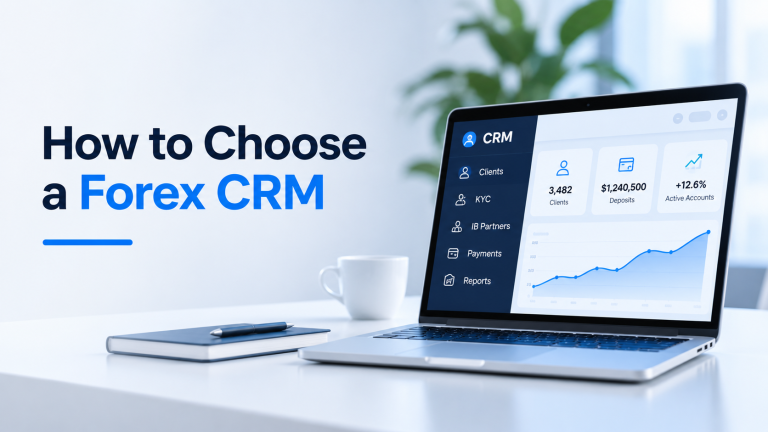

Operating a forex brokerage means managing the entire client journey. This includes signing up and verifying new clients, handling account funding, trade management, withdrawals, and partner relationships. Beyond that, firms must maintain compliance records and generate operational reports. These responsibilities highlight the need for a specialized system, known as a forex Customer Relationship Management (CRM) platform. But What is a forex CRM?
A forex CRM is software designed specifically to manage the complete client experience for forex and CFD brokers. It covers client onboarding, Know Your Customer (KYC) and Anti-Money Laundering (AML) checks, managing deposits and withdrawals, overseeing relationships with introducing brokers (IBs), and report generation. It also connects directly with trading platforms and payment systems.
What Is A Forex CRM and What Does It Do for a Broker?
In practice, a forex CRM consolidates scattered spreadsheets, manual compliance documents, and separate partner tracking tools into a single, centralized management system. Day-to-day, it performs four main functions:
Client Sign-Up and Lead Management
When someone interested in trading signs up on a brokerage’s website, the CRM records their contact details, source, and location.
Instead of leads sitting in unmonitored inboxes, they are automatically routed to the correct sales or retention representative. The system routes them based on factors like language, country, or the specific marketing campaign.
For instance, if a trader opens a demo account during European market hours, the system might automatically assign them to a regional sales team. All client interactions are logged afterward.
KYC checks
KYC procedures verify a client’s identity before they can trade. The CRM typically gathers identity and address documents, monitors their verification status (pending, approved, or rejected), and maintains a detailed audit trail.
Compliance requirements vary by regulator, so it’s always advisable to consult an advisor. Many CRMs integrate with outside verification services to authenticate documents, perform liveness checks, screen for Politically Exposed Persons (PEPs), and check against sanctions lists.
Deposits and withdrawals
The CRM records all payment requests, displays their status, and lets staff approve, reject, or investigate them.
When a client asks for a withdrawal, the CRM confirms there’s enough free margin in the account, checks for any compliance flags, and routes the transaction to finance for approval. Only then does it process the withdrawal via the payment provider.
Reporting
Management needs insights on sign-ups, funded accounts, net deposits, partner performance, and support team workload. Centralizing these reports in one system cuts down on manual reconciliation work.
Introducing broker management tracks multi-level referral networks. It calculates commissions based on volume, revenue share, or cost-per-acquisition rules, and provides partners with dedicated portals to see referred clients and their earnings.
Reporting dashboards show registrations, funding rates, trading volume, IB performance, deposit and withdrawal activity, and compliance metrics. Customizable report builders let teams pull out the data they need for management or regulatory filings, all without needing IT support.
Connecting the CRM to Trading Platforms, Cashier and Client Area
Operational efficiency relies on smooth data exchange between the CRM and other brokerage systems. Integration is vital for a CRM’s usefulness. Three connections stand out:
- Trading Platform: Integrating with platforms like MetaTrader 4, MetaTrader 5, or cTrader usually means using the platform’s Manager API. After a client completes KYC and puts money into their account, the CRM can tell the trading server to open a live account. This account will have the right group settings, leverage, and permissions.
- The cashier: This payment layer is where clients fund accounts and ask for withdrawals through payment service providers (PSPs). The CRM handles these transactions, matching every payment to the right client and trading account.
PSPs, card processors, bank transfer systems, and digital wallets all connect to the brokerage through a central cashier. When a trader deposits funds, the cashier confirms settlement with the PSP. It then automatically updates the CRM, crediting the client’s trading account. That way, there’s no need for manual ledger entries.
- The client area: This interface is what clients see. It displays their profile, uploaded documents, account balances, and payment requests. As the primary point of contact, if it’s slow or confusing, clients might abandon the onboarding process, even if the back office runs perfectly.
Assessing Value for Money: Modular Architecture vs. Rigid Bundles
Price is often a big consideration. These figures are illustrative industry estimates from forex CRM vendors and third-party market listings (as no single vendor publishes standardized pricing across all tiers), last read November 17, 2026:
For standalone SaaS forex CRM subscriptions, you’re generally looking at about $500 to $2,500 a month for entry-level systems. Mid-tier setups, handling multiple servers, might cost $3,000 to $8,000 monthly. Large, complex enterprise deployments can run $8,000 to $25,000 or even more each month.
Remember, these figures typically don’t include one-time setup fees or any custom integration work. A lighter white label brokerage costs about $5,000 to $25,000 to set up, according to Track360’s cost guide (read on November 17, 2026).
L7 Prime is modular. Clients can pick and choose individual components, perhaps a specific CRM or a trading platform. This flexible setup allows firms to build a tech stack that fits their current operations and future growth, ensuring they only pay for features they actually need.
Typically, according to L7 Prime’s onboarding overview, you can get a brokerage operation up and running in three to four weeks. Because L7 Prime is part of the ATFX group of companies, it integrates into a broader ecosystem. This includes institutional liquidity services, which many brokers find useful when establishing their full infrastructure.
Instead of making operators use a single proprietary back-office solution, L7 Prime lets them choose specific CRM, client and IB portals, onboarding workflows, and trading platform front-ends that fit their business model. These components are then brought together under a single implementation plan.
Still, it remains essential for brokers to do their own due diligence. This includes testing integrations with live data, getting compliance and operations teams involved in demonstrations, and making sure the chosen setup meets regulatory rules for their target markets.
What to Check Before Choosing a Forex CRM
Before signing off on a technology agreement, brokerage founders and operations managers should check a few practical points. This helps ensure the software fits their operational strategy. Our companion guide, How to Choose a Forex CRM (on L7 Prime’s Solutions hub), goes deeper. Here are the essentials:
- Fit with your model: A broker with a lot of introducing broker activity will need strong partner management tools. Brokers focusing on a specific region might prioritize local payment methods.
- Payment and eKYC Readiness: Check for pre-integrated regional payment gateways and identity verification providers, especially if you’re in multiple markets. Confirm compatibility with your chosen trading platform, and understand how to change platforms later. Make sure KYC status tracking, document storage, and audit trails meet regulatory expectations.
- Reporting: Ask for a demo using specific questions, like “show net deposits by partner last month.”
- Total cost: Consider license fees, setup costs, integration expenses, extra user licenses, and support charges. A low initial price might grow significantly over time.
- Exit terms: Look at contract duration, notice periods, and how to export your data if you decide to stop using the service.
- Speed to launch: Get a realistic implementation timeline in writing, and know what you need to do to meet it.
- Security and Role Permissions: A back-office system needs strict access controls, ensuring sales agents, finance officers, and compliance reviewers see only the client data relevant to their specific jobs.
Regulatory Responsibility and Next Steps
While the right technology makes daily administration, compliance tracking, and client onboarding smoother, the software alone won’t give you legal standing. Every brokerage is responsible for its corporate structure, regulatory approvals, and jurisdictional compliance.
L7 Prime doesn’t provide legal advice. Regulatory bodies make the final application decisions. Similarly, technology infrastructure helps operations run smoothly but can’t guarantee commercial success, regulatory approval, or profitability.
Bringing the Pieces Together
A good forex CRM cuts costs, gives clients a consistent experience, and creates the data trails compliance and management teams need.
It manages registration, verification, funding, partner relationships, and reporting. It also integrates tightly with the trading platform, cashier, and client area, making it the brokerage’s operational hub.
Modular offerings, like those from L7 Prime, give brokers a practical way to assemble the components they need without unnecessary complexity. For firms with established distribution channels or market expertise, getting operational in just three to four weeks can be especially appealing.
Established or rapidly scaling brokers, especially those with significant volume, often need full server control, custom plugins, the ability to offer their own sub-labels, or enterprise regulatory setups. Startups and smaller firms, however, usually find provider-hosted sub-licenses or alternative platforms a better fit, as these keep costs lower and help them launch faster.
As a practical first step in your own business, map out your target client workflow and ask each shortlisted CRM provider to quote every license, setup, integration, and support cost line in writing before committing. To explore modular brokerage infrastructure options, visit L7 Prime’s Forex Broker CRM page.